Portugal Is About to Rewrite the Golden Visa Rules

Last updated: 18 November 2026. This article covers a proposal now being voted on in Parliament. We will update it once the final text is approved.
In short
Portugal's governing parties want to tighten the rules for Golden Visa investment funds starting in 2027. Funds would have to invest more of their capital in Portuguese companies, and that money would have to arrive as fresh capital, not as shares or bonds bought on the market. Parliament votes in late November. Until then, nothing has changed.
Key takeaways
- The required investment in Portuguese companies would rise from 60% to 80% of a fund's capital.
- That investment would have to strengthen the companies' share capital. Listed shares and bonds bought on the market would likely stop counting.
- Open-ended funds built on listed securities face the biggest questions. They are not banned.
- Applications already submitted are expected to keep the current rules.
- The final budget vote is scheduled for 24 November 2026, and the new rules could apply from 1 January 2027.
What are the current Portugal Golden Visa fund rules?
Today, you qualify for Portugal's Golden Visa by investing €500,000 in a Portuguese fund that is not a real estate fund. The fund must put at least 60% of its capital into companies headquartered in Portugal, and it must have a maturity of at least five years.
Funds have been the main route since real estate was removed from the programme in 2023, and the market has grown fast. But not all funds invest the same way. Some put their capital directly into private Portuguese companies. Others, mostly open-ended funds, hold largely listed Portuguese shares and corporate bonds.
What does the new proposal change?
The amendment, filed on 6 November 2026 by the governing PSD and CDS-PP parties, tightens the fund route in two ways and adds two cheaper routes.
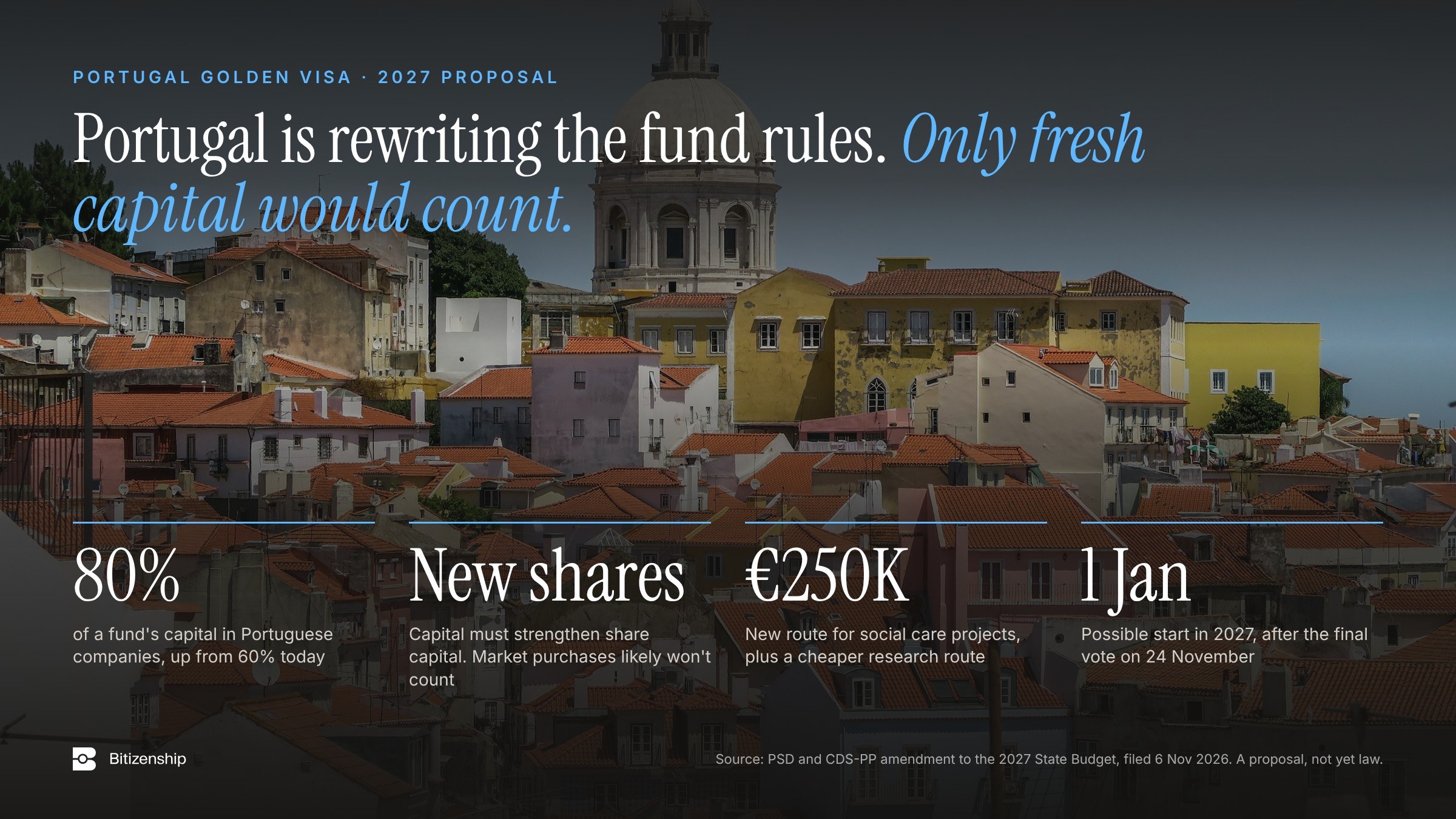
A higher local quota. Funds would have to invest four fifths of their capital in Portuguese companies, up from three fifths today.
Fresh capital only. The money would have to reach those companies as new share capital. When a fund buys shares on the stock exchange, the cash goes to the seller, not to the company. On the most common reading of the text, those purchases would no longer count, and neither would bonds or shareholder loans.
A new social route. A €250,000 contribution to projects that build or restore social care facilities, paid through a closed list of public and charitable institutions.
A cheaper research route. The minimum contribution to scientific research would be halved.
Does the proposal ban open-ended Golden Visa funds?
No. The text doesn't mention open-ended funds and doesn't ban them. But it would be much harder for them to qualify.
An open-ended fund has to stay partly liquid so it can pay investors who want to leave. Liquid usually means listed shares and bonds, which is exactly what the new wording seems to exclude. Private company shares, on the other hand, can't be sold quickly. Lawyers who have reviewed the text expect funds invested mainly in listed shares or debt to lose eligibility for new investors unless they change strategy. Closed-ended funds that invest directly in Portuguese companies are already close to what the law now describes.

When could the new rules apply?
If the budget passes with this amendment, the new rules could apply from 1 January 2027.
- 6 November 2026: amendment filed
- 18–23 November 2026: committee votes on budget amendments
- 24 November 2026: final vote on the State Budget
- 1 January 2027: possible entry into force
The outcome is not certain. The governing parties don't have a majority on their own and need other parties to support the amendment or abstain. The text may also change before the final vote.
Are existing investors and pending applications protected?
As drafted, applications already submitted are expected to stay under the current rules. Several questions are still open and will probably only be answered in 2027.
- Invested but not yet applied. Protection appears to depend on the date you apply, not the date you invest.
- Renewals and family reunification. Current permit holders are expected to keep today's rules, but the text doesn't say so explicitly.
- How "share capital" is measured. Usually only part of an investment is recorded as share capital, and the text doesn't say how this will be counted.
- Official guidance. Portugal's immigration agency (AIMA) and securities regulator (CMVM) will likely need to explain how the rules work in practice.
Why doesn't Bitizenship Capital run open-ended funds?
Because we read the Golden Visa law as asking for a long-term commitment to Portugal, not a short-term position in its markets.
From the start, our reading was that the law wants capital that stays invested in the country for the full required period, with a margin of safety on top. Buying bonds or listed shares can meet the letter of the rules. In our view it misses their spirit: the money moves around the markets without necessarily building anything new in Portugal.
That is why Bitizenship Capital, our licensed fund manager in Portugal, does not run open-ended funds. Neither of the funds it manages is open-ended.
Where does Bitizen One stand?

Bitizen One (formerly Unbound) is a closed-ended, Golden Visa-eligible private equity fund that invests in a fully owned Portuguese company focused on the Bitcoin ecosystem. It runs until 2032. That is the kind of fund the new rules are moving toward.
The fund doesn't hold a portfolio of listed shares or bonds. Its capital goes to a company that operates in Portugal, with its own team and activity, and stays there for the life of the fund. When the final text is approved, we will review it with our lawyers and make any adjustments it requires.
Like any private equity investment, Bitizen One carries risk: investors can lose capital, liquidity is limited, and returns are not guaranteed. Always refer to the fund's official documents.
What does this tell us about Portugal's direction?
Portugal's Golden Visa has changed many times. Real estate was removed, the nationality law was revised, and now the fund route is being tightened. Each time the direction has been the same: the rules move closer to their original purpose, which is real, long-term investment in the country.
We have written before that optionality is built slowly. Structures work the same way. If a structure was built around the spirit of the law, it doesn't need to chase every amendment. If it was built only around the letter, it has to be rebuilt every time the letter changes.
What should you do if you're considering Portugal now?
Don't rush, and don't panic. Until the new rules are approved and published, today's rules apply.
- Already applied: your application is expected to stay under the current rules. Watch for official guidance on renewals.
- Invested but not yet applied: talk to your lawyer about when to file.
- Still choosing a fund: ask whether it's open-ended or closed-ended, what it actually invests in, and how it would meet a four-fifths quota built on fresh capital.
To understand how these changes apply to you, get in touch through the form on this page.
FAQs
Is the Portugal Golden Visa ending?
No. The proposal changes the investment rules for funds and adds new routes. The programme stays open.
What is the new Portugal Golden Visa fund rule?
Under the proposal, a qualifying fund must invest at least 80% of its capital in Portuguese companies, as new share capital rather than market purchases.
When do the new Golden Visa rules start?
If approved with the 2027 State Budget, they could apply from 1 January 2027. The final vote is scheduled for 24 November 2026.
Will open-ended funds still qualify?
They are not banned. Funds invested mainly in listed shares or bonds may lose eligibility for new investors unless they change strategy.
Are existing Golden Visa applicants affected?
Applications already submitted are expected to stay under the current rules. Renewals have not yet been explicitly addressed.
Is Bitizen One an open-ended fund?
No. Bitizen One is a closed-ended private equity fund that runs until 2032 and invests in a fully owned Portuguese company.
Does this change affect Portuguese citizenship?
No. Citizenship follows the Nationality Law: 10 years of legal residence counted from the first residence permit, or 7 for EU and CPLP nationals. Permanent residence remains available after 5 years. Neither is automatic or guaranteed.
Read next
- Golden Visa Program Risks in 2026: EU Pressure, Past Closures, and Which Programs Could End Next
- Portugal's 2026 Nationality Law
- How to Build Optionality Before You Need It
Disclosure:
This article is published by Bitizenship. Bitizenship Capital SCR, S.A., an asset manager registered with the Portuguese Securities Market Commission (CMVM) and part of the Bitizenship group, manages Bitizen One (formerly Unbound), the fund referred to in this article. Bitizenship therefore has an interest in the matters discussed.
Disclaimer:
This article is a commentary on the policy and regulatory evolution of the investment migration industry. It is published for informational and educational purposes only and is not legal, tax, immigration, investment or financial advice. It is not an offer or solicitation to subscribe to any fund or investment product. Following a resolution of the fund's general meeting, Bitizen One is open to a limited number of new subscriptions; any subscription may only be made on the basis of the fund's management regulations and offering documents. Investing in a closed-ended private equity fund involves risk, including the loss of all capital invested, and limited liquidity until the end of the fund's term. The changes described are a legislative proposal under parliamentary discussion: the final text, and how AIMA and the CMVM apply it, may differ, and no fund's continued eligibility for the Golden Visa can be guaranteed. Program terms, eligibility criteria, processing times and tax regimes change frequently and vary by individual circumstances. Review the official documentation and consult independent legal, tax and financial advisors before making any decision. Past performance does not guarantee future results. Residency and citizenship outcomes depend on meeting all legal, language, residency and integration requirements and are never guaranteed.
Photo credits
The photos in this article come from Unsplash. Thank you to João Reguengos (Lisbon), Denise Jans (Lisbon rooftops), Anna Dziubinska (Lisbon street) and Vitalii Kyktov (Porto). The slides are by Bitizenship.

Let’s keep in touch.
Every so often, a letter from us on new residencies, new citizenships and a freer way to live.
