The Wealth Migration Report 2026
.png)
Wealth migration has become one of the defining economic stories of the decade, and 2026 is set to break every record that came before it.
In 2025, 36% of billionaires relocated at least once, with another wave actively planning moves for the year ahead (Source: UBS Billionaire Ambitions Report 2025).
The numbers point to a structural shift rather than a passing trend: the world's wealthiest families are no longer thinking about a single move to a single country, but about assembling rights, residencies, and investments across several jurisdictions at once.
At Bitizenship, we track this shift closely because it sits at the center of how Bitcoin-aligned investors are now planning their mobility.
This report breaks down the 2026 data, the forces behind it, and what it means for anyone considering a second residency.
Key Takeaways
- A record 165,000 millionaires are projected to relocate internationally in 2026.
- Wealth migration is shifting from single moves toward multi-country sovereign portfolios.
- Italy and Portugal both rank among 2026's most competitive wealth destinations.
- Bitizenship gives Bitcoin-aligned investors compliant wealth migration routes into Portugal and Italy.
- The UK leads global outflows, while the UAE, US, and Italy lead inflows.
The State of Wealth Migration in 2026
The headline figure for 2026 is the largest movement of private wealth ever recorded. Roughly 165,000 millionaires are projected to relocate internationally this year, up from 142,000 in 2025, which was itself a record at the time (Source: New World Wealth).
To put that in perspective, more than 600 high-net-worth individuals are expected to move countries on every working day of 2026.
The trajectory over the past decade shows how dramatic the acceleration has been:
- 2013: roughly 51,000 millionaire relocations.
- 2019: roughly 110,000, just before the pandemic slowdown.
- 2023: 120,000 as mobility rebounded.
- 2024: 134,000.
- 2025: 142,000, a record year.
- 2026: 165,000 projected, the highest on record.
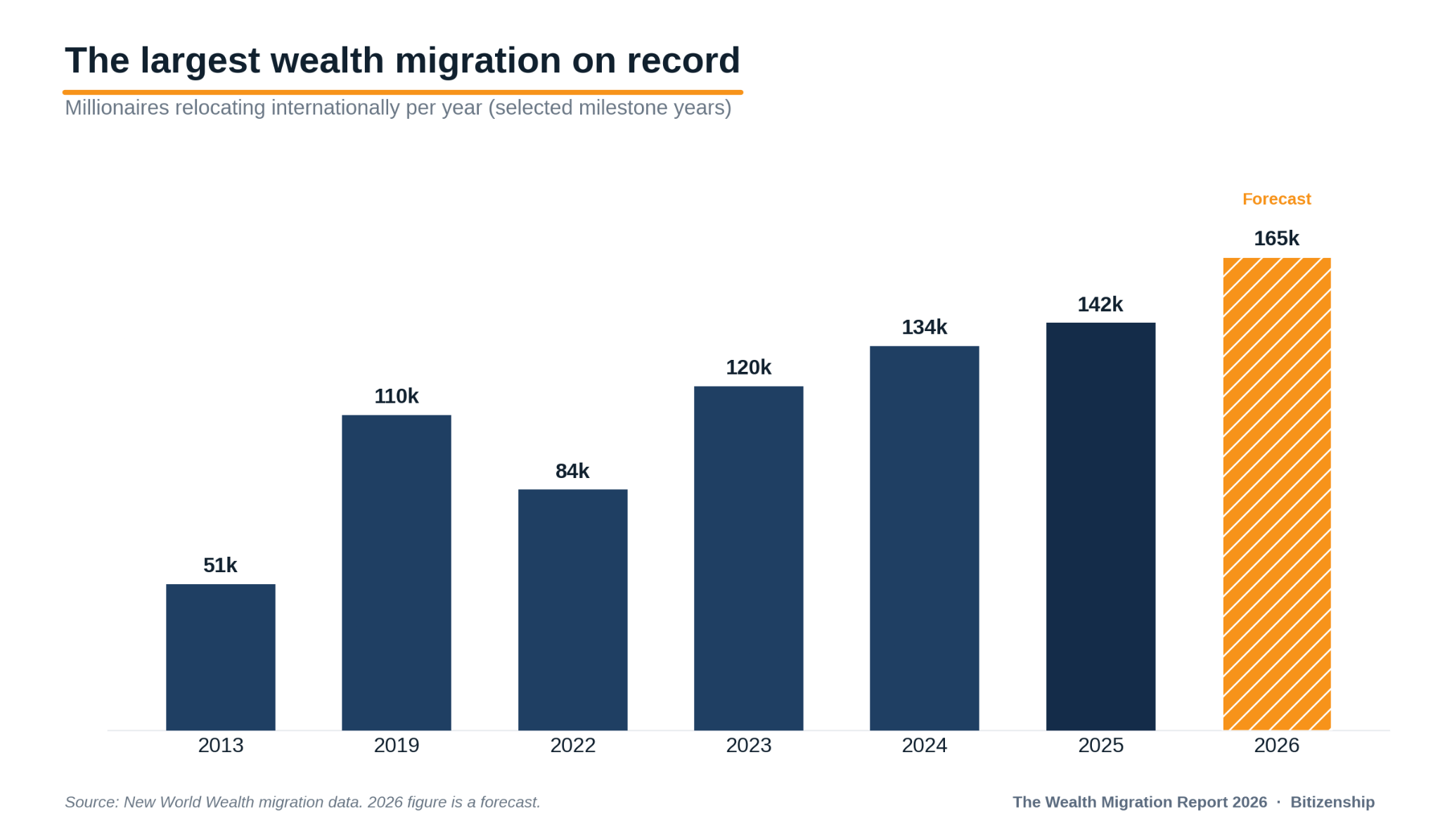
This is no longer a niche behavior confined to a handful of tax exiles. It is a sustained, multi-year climb that reflects how mobility has become a core part of wealth planning
Where the World's Wealth is Moving
The 2026 flows reveal clear winners and clear losers, and the gap between them is widening.
On the inflow side, established hubs and lifestyle destinations dominate. On the outflow side, a small number of high-tax economies account for most of the departures.
The projected net millionaire flows for 2025 and 2026 break down as follows:
- United Arab Emirates: net inflow of roughly +9,800, the top destination for the fifth year running.
- United States: roughly +7,500, still a powerful magnet for mobile wealth.
- Italy: roughly +3,600, one of Europe's standout gainers.
- Switzerland: +3,000, with Saudi Arabia at +2,300 and Singapore at +1,600.
- Portugal: +1,400, with Greece at +1,200.
- United Kingdom: net outflow of roughly -16,500, the largest single-country loss ever tracked.
- China: -7,800, India: -3,500, South Korea: -2,400, Russia: -1,500.
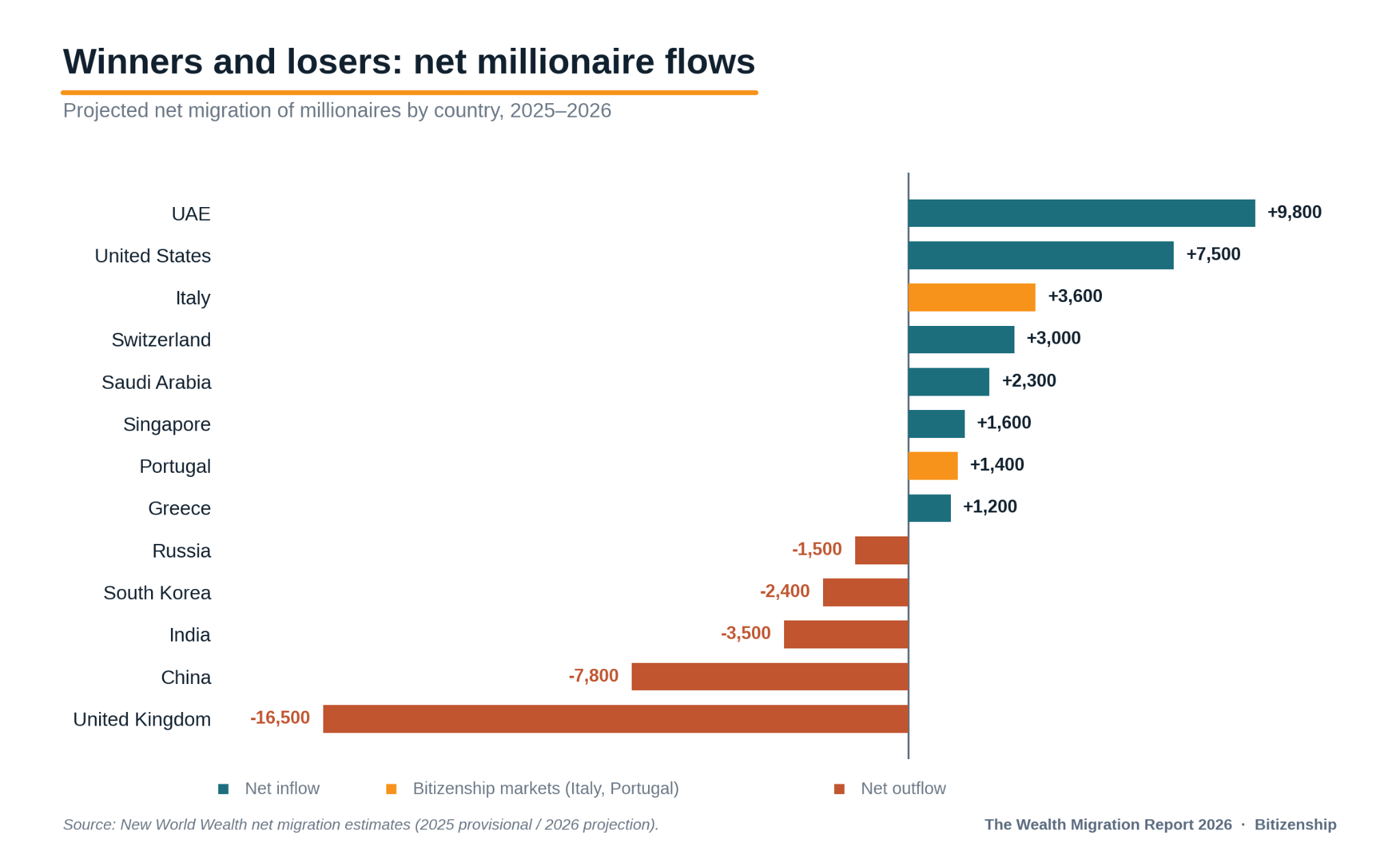
The European picture is especially relevant for Bitcoin-aligned investors, because Italy and Portugal both appear firmly on the inflow side. Italy's strong gain reflects the stability of its Investor Visa program, the same legal route that underpins the Bitizenship Portugal Fund and Bitizenship's Italian pathway.
Both countries are attracting capital while several of their neighbors tighten or close their doors.
Measuring What Makes a Jurisdiction Competitive
Raw flow numbers tell you where wealth went, but not why. The most useful framing in 2026 is a wealth mobility competitiveness approach that scores jurisdictions from 0 to 100 across factors like tax treatment, rule of law, quality of life, migration pathways, capital mobility, and geopolitical stability. It explains the structural reasons one country attracts mobile wealth while another loses it.
The selected 2026 competitiveness scores show a clear hierarchy:
- Singapore leads at 79.5, followed by New Zealand at 75.8.
- Cayman Islands 74.3, Cyprus 73.5, and Netherlands 72.8 round out the upper tier.
- Portugal scores 72.5 and Italy 72.3, placing both among Europe's most competitive destinations.
- Switzerland 70.8 and Greece 70.5 remain strong.
- Germany (69.7), Norway (69.0), the United Kingdom (68.3), South Korea (66.2), and France (65.7) are classified as competitive jurisdictions under pressure.
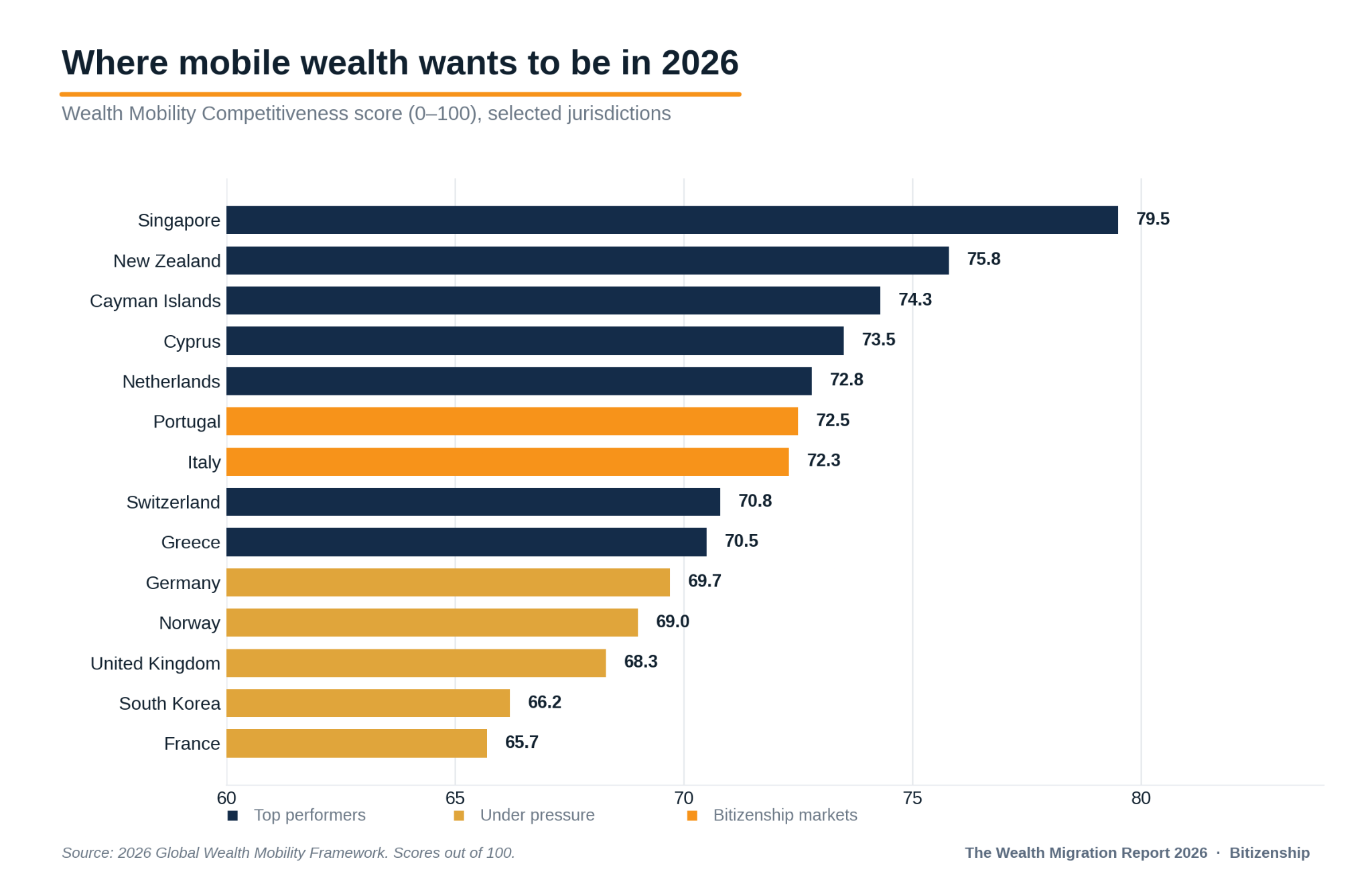
The important takeaway is that the old "West versus the rest" framing no longer holds. Some Western jurisdictions remain highly competitive, while others are slipping because of policy shifts and fiscal uncertainty.
Portugal and Italy, the two countries behind Italy's Investor Visa and Portugal's fund route, both sit in the attractive tier, which is one reason they feature so heavily in modern mobility planning.
Why the Wealthy are Moving in 2026
The motivations behind these moves have matured. Tax efficiency still matters, but it now sits alongside concerns that are just as pressing for high-net-worth families. The 2026 data points to three drivers of roughly equal weight.
The leading reasons cited by relocating billionaires are:
- Better quality of life: cited by 36%.
- Major geopolitical concerns: cited by 36%.
- Tax efficiency: cited by 35%.
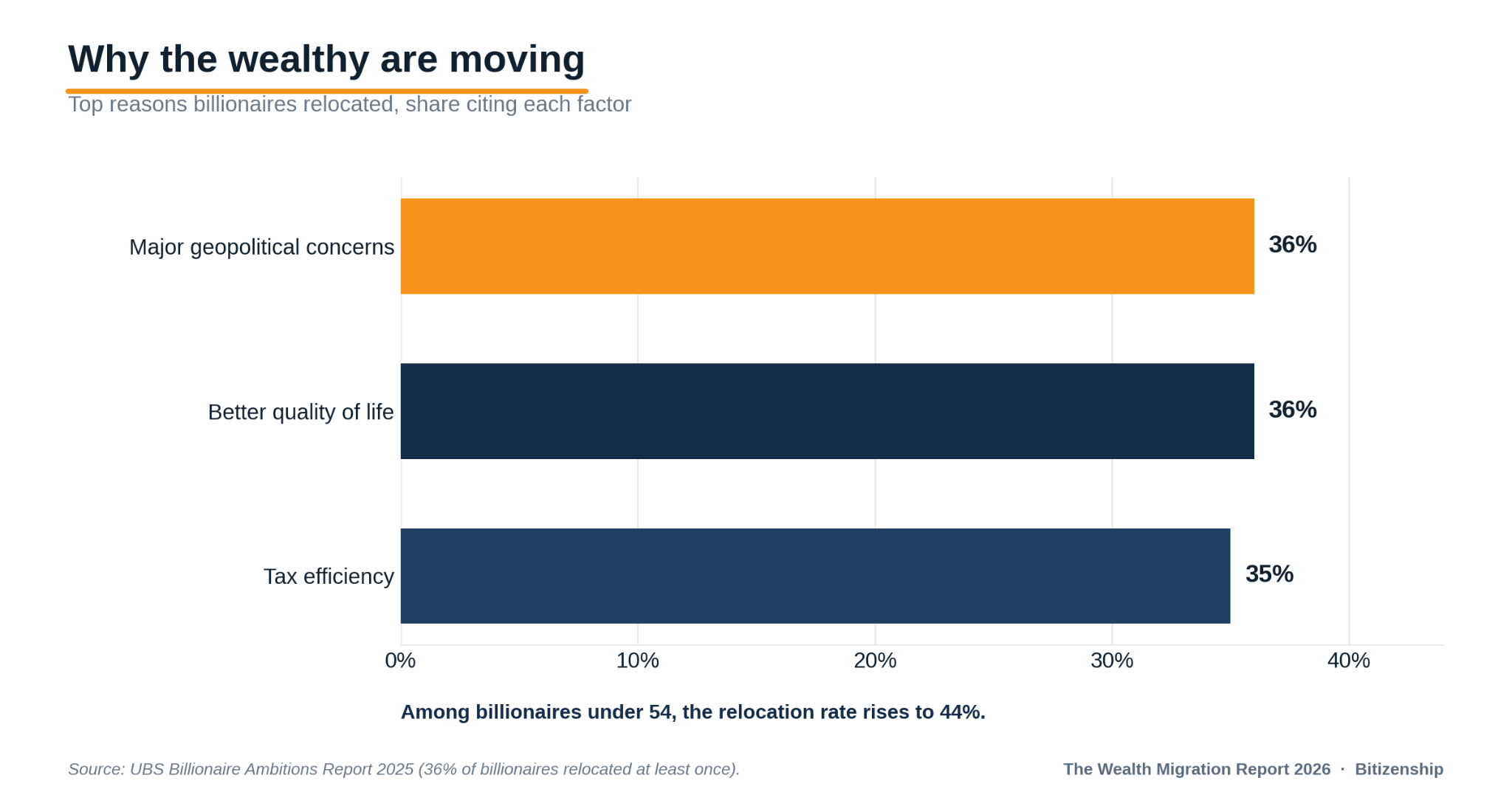
Notably, the relocation rate climbs to 44% among billionaires under 54, suggesting that younger wealth holders treat mobility as a default strategy rather than a last resort (Source: UBS Billionaire Ambitions Report 2025).
This generational angle matters for the Bitcoin-aligned audience, which skews younger and already thinks in terms of optionality and sovereignty.
The Rise of the Sovereign Portfolio
The single biggest narrative shift in 2026 is the move away from "single-base" thinking toward what is increasingly called a sovereign portfolio: a deliberate spread of residence rights, citizenships, investments, and business interests across multiple countries.
Wealthy families are starting to treat jurisdictional exposure the way they treat asset allocation.
The data behind this shift is striking:
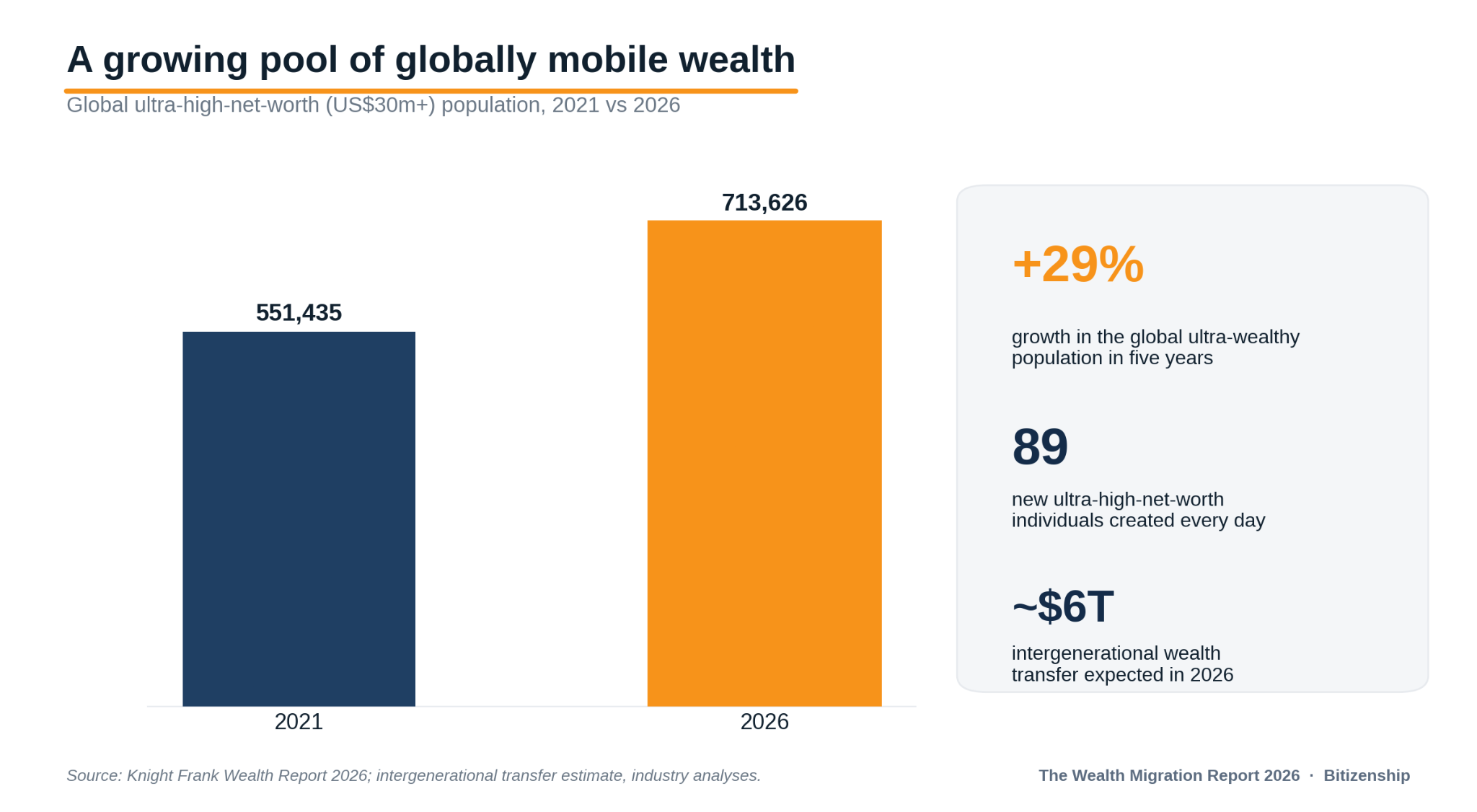
- The global ultra-high-net-worth population (US$30m and above) grew from 551,435 in 2021 to 713,626 in 2026, roughly 29% in five years (Source: Knight Frank Wealth Report 2026).
- That works out to roughly 89 new ultra-wealthy individuals created every day.
- An estimated US$6 trillion in intergenerational wealth is expected to transfer in 2026, accelerating cross-border restructuring.
- In the first five months of 2026, applications came from 86 nationalities across 47 investment migration programs, and over 28% of applicants already lived outside their country of nationality (Source: New World Wealth).
A larger, younger, and more global pool of wealth means more demand for structured, compliant routes into stable jurisdictions. This is precisely the environment in which regulated investment routes, including Portugal Golden Visa funds, have become central to long-term planning rather than a fringe option.
What This Means for Bitcoin-Aligned Investors
For Bitcoin holders, the 2026 data lands differently than it does for traditional wealth. The sovereign-portfolio mindset, freedom, optionality, and exposure to assets you believe in, maps almost perfectly onto the Bitcoin worldview. The challenge has always been finding a residency route that does not force you to abandon your core position to satisfy a regulatory requirement.
Bitizenship structures two compliant, Bitcoin-aligned routes into Europe that align with these trends:
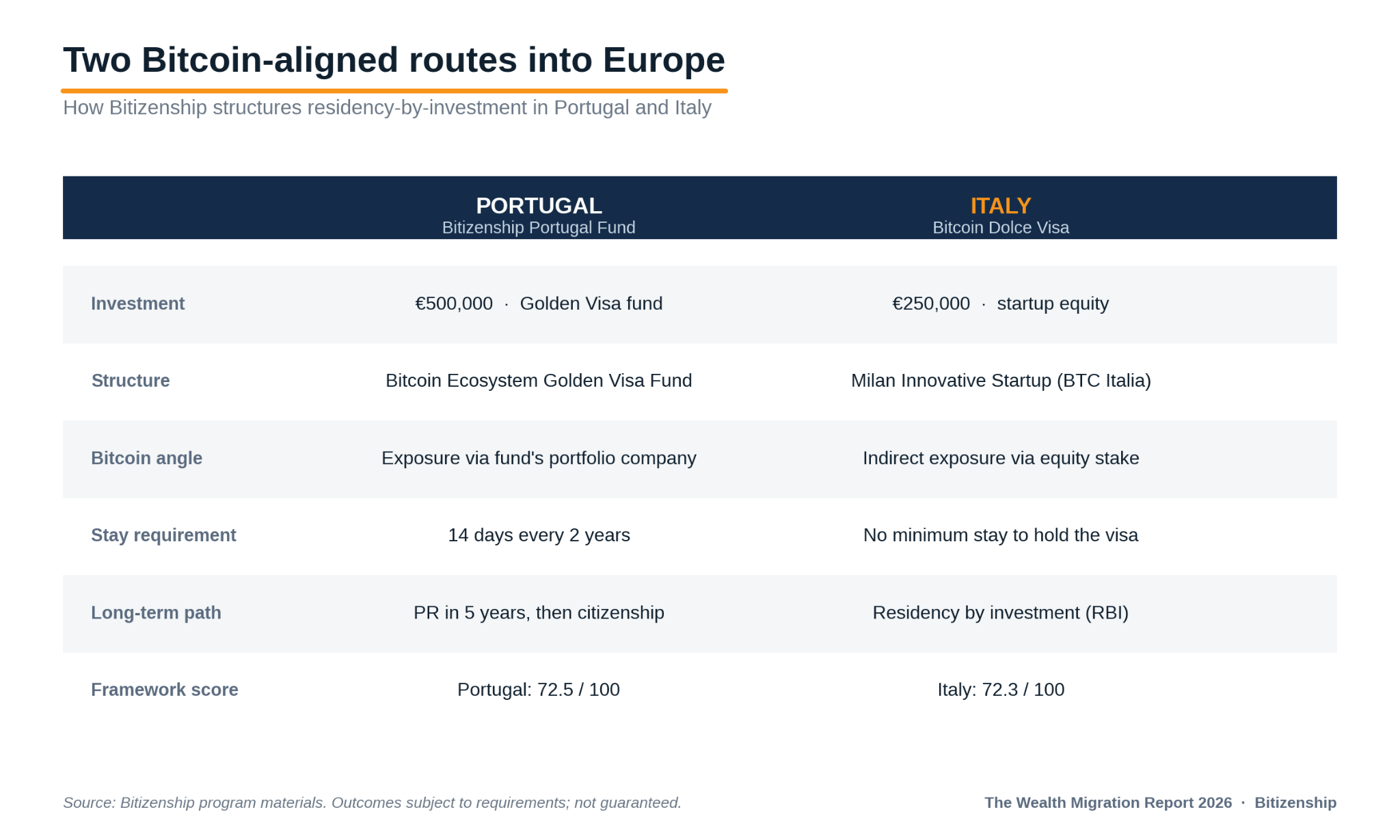
- The Bitizenship Portugal Fund is a Golden Visa-eligible private equity fund that invests in a fully owned Portuguese company focused on the Bitcoin ecosystem. It requires a €500,000 qualifying investment, made by euro bank transfer rather than in Bitcoin, with a stay requirement of just 14 days every two years.
- The Bitcoin Dolce Visa is Bitizenship's Italian Investor Visa pathway, built around a €250,000 equity stake in Bitizenship Italia S.r.l. (BTC Italia), a Milan-based Innovative Startup whose treasury is held in BTC as working capital for non-custodial Bitcoin Layer-2 validation and related research.
Both routes provide indirect Bitcoin ecosystem exposure through the activities of the investment vehicle, not through a direct Bitcoin purchase made on investors' behalf.
The structural distinction is important and worth stating plainly:
- Portugal's fund route offers a pathway to permanent residency in five years, with citizenship as a later pathway, while requiring minimal physical presence.
- Italy is a pure residency-by-investment route: it grants residency, and citizenship by naturalization only becomes possible after ten years of continuous legal residence at 183 or more days per year, subject to language and integration requirements.
For investors weighing whether they can even fund these routes with crypto, our guide on whether you can pay with Bitcoin walks through the compliance reality.
How Bitizenship Sees the Next 12 Months
We expect the trends in this report to intensify rather than reverse. As more European programs are restricted or repriced, the jurisdictions that combine stability with flexibility will keep pulling ahead, and Italy and Portugal are well positioned within that group. We also expect the sovereign-portfolio approach to become the default among younger, Bitcoin-aligned investors who already think in decades and in optionality.
Our forward view for the year ahead rests on a few expectations:
- Demand for compliant, structured residency routes will keep rising as wealth becomes more mobile and more global.
- Bitcoin-aligned investors will increasingly seek mobility solutions that preserve exposure to the asset class they believe in.
- Regulatory precision will matter more, not less, which is why founder-led legal oversight and a vetted partner network sit at the core of how we work.
If you want to understand how this maps to your own situation, the team behind Bitizenship combines investment migration experience with Bitcoin-native structuring and founder-led oversight, and can walk you through the Bitcoin Dolce Visa and the Portugal Fund in detail.
"Bitcoin holders aren't a new type of investor. They're a new type of citizen. They think in decades, in optionality, in sovereignty. We built Bitizenship for that person." — Alessandro Palombo, Co-Founder, Bitizenship
Conclusion
The 2026 wealth migration data confirms a structural change that is unlikely to slow: a record 165,000 millionaires are on the move, driven by quality of life, geopolitical caution, and tax planning in roughly equal measure, and they are increasingly building multi-country sovereign portfolios rather than making single relocations.
Italy and Portugal stand out as two of Europe's most competitive and compliant destinations within that shift, which is exactly where Bitizenship focuses its Bitcoin-aligned residency routes.
For investors who see Bitcoin as part of a broader philosophy of freedom and optionality, the trend lines all point in the same direction.
Get in touch to explore how a Bitcoin-aligned residency pathway could fit your goals.
Read Next:
- Getting Residency in Italy in 2026: Top 30 Questions Answered
- 3 Reasons Why Most Golden Visa Buyers Choose the Wrong Program
- Can Bitcoin Be Used to Qualify for a Golden Visa?
FAQs:
1. What is driving wealth migration in 2026?
Wealth migration in 2026 is driven by three roughly equal forces: quality of life, geopolitical uncertainty, and tax efficiency. A record 165,000 millionaires are projected to relocate internationally, and a growing share are building multi-country sovereign portfolios rather than moving once. Bitizenship helps Bitcoin-aligned investors respond to these trends through compliant residency routes in Portugal and Italy.
2. Which countries are winning the wealth migration race in 2026?
The biggest wealth migration gainers in 2026 are the UAE and the United States, followed by European destinations including Italy, Switzerland, and Portugal. The United Kingdom records the largest outflow, with China and India also losing high-net-worth residents. Bitizenship focuses on Italy and Portugal, two of Europe's most competitive destinations for mobile wealth.
3. How does wealth migration affect Bitcoin holders specifically?
Wealth migration trends align closely with the Bitcoin worldview of freedom, optionality, and sovereignty, especially among younger investors who treat mobility as a default strategy. The challenge is finding a residency route that preserves exposure to Bitcoin. Bitizenship addresses this with two Bitcoin-aligned pathways that offer indirect Bitcoin ecosystem exposure through regulated investment vehicles.
4. Are Italy and Portugal good destinations in the 2026 wealth migration data?
Yes, both Italy and Portugal rank among the most competitive wealth migration destinations in 2026, scoring 72.3 and 72.5 respectively on a 0 to 100 competitiveness measure, and both appear on the inflow side of net millionaire flows. Bitizenship structures compliant residency-by-investment routes in each country for Bitcoin-aligned investors.
5. How can Bitizenship help with a wealth migration strategy?
Bitizenship helps Bitcoin-aligned investors turn the wealth migration trend into a concrete plan through two routes: the Bitizenship Portugal Fund, a Golden Visa-eligible private equity fund, and the Bitcoin Dolce Visa, an Italian Investor Visa pathway. Both come with administrative support, vetted legal and tax partners, and founder-led oversight, with outcomes always subject to the relevant legal requirements.
Disclaimer:
This article is published by Bitizenship for informational and educational purposes only. It reflects Bitizenship's perspective on the investment migration market and is not intended as legal, tax, immigration, investment, or financial advice, nor as an offer or solicitation to subscribe to any investment product. Comparisons with other firms are based on publicly available information and our own assessment of structural differences in business models. We have aimed for accuracy, but descriptions of programs, regulations, and competitor offerings are necessarily summaries and may not capture every legal nuance. Program terms, eligibility criteria, processing times, tax regimes, and regulatory frameworks change frequently and vary by individual circumstances. The Bitcoin Dolce Visa involves an equity investment in Bitizenship Italia S.r.l., an Italian private company. Any investment decision should be made only after reviewing the official documentation and consulting independent legal, tax, and financial advisors qualified in the relevant jurisdictions. Past performance does not guarantee future results. Capital is at risk. Residency and citizenship outcomes depend on meeting all legal, language, residency, and integration requirements set by the relevant authorities and are never guaranteed. Always refer to official government and regulatory sources, and engage qualified professionals before acting on any information in this article.
Gain European residency and citizenship for you and your family. Enjoy the freedom to live, work, do business.
