How EU Residency Protects Your Property for Your Heirs: Inheritance Benefits Every Real Estate Owner Should Know

EU residency inheritance benefits are one of the least discussed reasons real estate owners pursue a European residence permit, yet for families with property on the continent they may be the most consequential.
Roughly $124 trillion is expected to pass from baby boomers to younger generations by 2048, the largest intergenerational wealth transfer in history (Source: Cerulli Associates, cited by Fortune, July 2026).
A meaningful share of that wealth sits in bricks and mortar, and a growing portion of it sits in European bricks and mortar owned by non-EU nationals.
What many of those owners don't realise is that residency status can shape which succession law applies to their estate, which tax regime their heirs face, and whether those heirs can actually live in and manage what they inherit.
Bitizenship helps Bitcoin-aligned investors pursue European residency through compliant investment pathways in Portugal and Italy, and this guide breaks down how those pathways intersect with inheritance planning for property owners.
Key Takeaways
- EU residency can influence which country's succession law governs your estate.
- Portugal levies no inheritance tax on transfers to spouses, children, or parents.
- Italy taxes spouses and children at 4% only above €1 million each.
- Bitizenship's Portugal and Italy pathways include family members in the residency application.
- Residency doesn't guarantee outcomes; wills, tax advice, and structure still matter.
Why Property Ownership Alone Doesn't Protect Your Heirs
Buying a villa in the Algarve or an apartment in Milan gives you an asset. It doesn't give your heirs a plan. Ownership and succession are governed by different rules, and the gap between them is where families lose money, time, and sometimes the property itself.
Here's what typically goes wrong when a non-resident owner dies holding European real estate:
- The estate may be subject to conflicting succession laws from two or more countries.
- Heirs may face local inheritance or transfer taxes they didn't anticipate.
- Probate can stall for months while foreign documents are apostilled and translated.
- Heirs without residency rights may be limited to short tourist stays while managing the asset.
- Forced heirship rules in civil-law countries can override a will drafted at home.
Residency doesn't eliminate any of these issues on its own, but it changes the starting position. That's the theme of every section below, and it's also why the team at Bitizenship encourages clients to think about the real estate advantage of residency long before the estate is ever tested.
How EU Residency Shapes Which Succession Law Applies
The single most important legal concept for property owners to understand is the EU Succession Regulation, often called Brussels IV. It has applied since August 2015 in most EU member states, including Portugal and Italy, and it determines whose law governs your entire estate.
Under the Regulation, the default rule is this:
- The law of the country where you were habitually resident at the time of death governs your succession, covering movable and immovable assets worldwide.
- You can override the default by choosing the law of your nationality in a will or similar document.
- Portugal and Italy both apply the Regulation; Denmark and Ireland opted out.
- The European Certificate of Succession lets heirs prove their status across participating states with one document.
"Habitual residence" is a factual test, not a paperwork test. A residence permit doesn't automatically make a country your habitual residence, and spending most of your year elsewhere may point the other way. But a permit, a local tax number, a bank account, and a documented pattern of presence are exactly the kinds of facts courts weigh.
Residency gives you the option to build a coherent succession position around Portugal or Italy, and to pair it with an explicit choice of law if that better serves your heirs. That's the practical meaning of "protection" here: control over which rulebook your family inherits under, rather than leaving it to chance.
Forced Heirship: The Rule Common-Law Owners Overlook
Both Portugal and Italy reserve a portion of the estate for close family members regardless of what a will says. Portugal calls this the legítima; Italy calls it the legittima or quota di riserva.
If Portuguese or Italian law ends up governing your estate, expect the following:
- A protected share is reserved for the spouse and descendants, and in some cases ascendants.
- Only the remaining "disposable" portion can be freely gifted by will.
- Attempts to disinherit a protected heir can be challenged and reduced.
- A choice-of-law clause selecting your nationality's law may let you avoid these rules, depending on your home jurisdiction.
For an owner from the US, UK, Canada, or Australia, this is often the deciding factor in whether to elect home-country law. For an owner who wants the property to pass to a spouse and children in fixed shares, forced heirship is a feature rather than a bug. Either way, it's a decision to make deliberately, and the Portugal program or Italy program is the moment most Bitizenship clients first confront it.

Portugal: What Residency Means for Inheritance of Property
Portugal is unusually friendly to heirs. The country abolished its inheritance and gift tax in 2004 and replaced it with a narrow stamp duty, Imposto do Selo, that most family transfers never trigger.
The rules that matter for property owners:
- Transfers to a spouse (or recognised união de facto partner), children, grandchildren, parents, and grandparents are fully exempt.
- All other beneficiaries pay a flat 10% stamp duty, plus an additional 0.8% on real estate, for a combined 10.8% on property.
- The duty applies only to assets located in Portugal, regardless of where the deceased or the heir lives.
- Foreign assets, including a US brokerage account or a London flat, fall outside the Portuguese net entirely.
- Stepchildren are not treated as direct descendants unless legally adopted.
Notice what this means: for a direct-line family, Portuguese property passes with no Portuguese inheritance tax whether or not the owner held residency. So where does residency add value?
The Practical Edge of Portuguese Residency for Heirs
Residency in Portugal matters less for the tax rate and more for everything around it.
Consider the difference for a family where the owner holds a Golden Visa:
- Qualifying family members are included in the residency application, so heirs typically already hold their own permits.
- Heirs with residency can live in the inherited property year-round rather than counting 90-day Schengen stays.
- Building habitual residence in Portugal supports a clean, single-jurisdiction succession under Brussels IV.
- After 5 years from issuance of the first residence card, holders may become eligible for permanent residency, and the investment can then be exited while the family retains its status.
- A Portuguese will, drafted alongside a home-country will, can be executed locally with far less friction.
Bitizenship's Portugal Fund is a Golden Visa-eligible private equity fund pathway built around a €500,000 qualifying investment into a fund that owns a Portuguese company focused on the Bitcoin ecosystem.
Real estate no longer qualifies for the Golden Visa, so the fund route is how many property owners now secure the residency that makes their existing home in Portugal easier to pass on. Stay requirements are minimal at 14 days every 2 years, and the pathway leads to permanent residency eligibility after 5 years, with a consequential path to citizenship subject to Portugal's revised Nationality Law and all language, residency, and integration requirements.
Investors should note that the investment must be made by bank transfer, not in Bitcoin, and that fund investments carry risk, including possible loss of capital.
For a wider view of what changed in 2026, the team wrote about Portugal's new tax regime for resident property owners.
Italy: What Residency Means for Inheritance of Property
Italy does levy inheritance and gift tax, but at some of the lowest rates in Western Europe, and with generous per-heir allowances that shelter most family homes entirely.
The rates as of 2026 (Legislative Decree 139/2024, in force since January 2025):
- Spouse and direct descendants: 4%, applied only above a €1 million allowance per beneficiary.
- Siblings: 6%, applied above a €100,000 allowance per beneficiary.
- Other relatives up to the fourth degree: 6% with no allowance.
- Unrelated beneficiaries: 8% with no allowance.
- Since January 1, 2026, lifetime gifts and inheritance are assessed separately, so a €900,000 gift to a child during your lifetime no longer erodes that child's €1 million inheritance allowance.
Two further points work strongly in a property owner's favour:
- Italian real estate is valued for inheritance tax using the revalued cadastral income, which is frequently well below market value.
- The succession declaration (dichiarazione di successione) doubles as the instrument that transfers title, so the process is administrative rather than adversarial when documents are in order.
Residency, the Flat Tax Regime, and Foreign Assets
Here's the nuance that separates a resident owner from a non-resident one in Italy. If the deceased was an Italian tax resident, Italian inheritance tax applies to worldwide assets, with credits for foreign tax paid. If the deceased was non-resident, only Italian-sited assets are in scope.
That sounds like a reason to avoid tax residency, until you factor in Italy's flat tax regime for new residents:
- Qualifying new residents pay a flat €300,000 per year on all foreign-sourced income, with €50,000 per additional family member, for up to 15 years (rates as of January 1, 2026).
- Under the regime, inheritance and gift tax on foreign assets is also covered by the annual substitute payment.
- The regime exempts holders from IVAFE (0.2% on foreign financial assets) and IVIE (0.76% on foreign real estate).
- Italian-sited assets, including an Italian home, remain subject to standard Italian rules, which for a spouse or child means the 4% rate above €1 million.
For a globally diversified family with a property in Italy and substantial holdings elsewhere, this combination can be a coherent estate structure rather than a tax trap. Italy's investor visa also has no minimum stay requirement to maintain the permit, which gives owners flexibility over when they become tax resident. This is a planning decision, not a default. Discuss it with a cross-border tax advisor before arriving, because the regime cannot be re-entered once revoked.
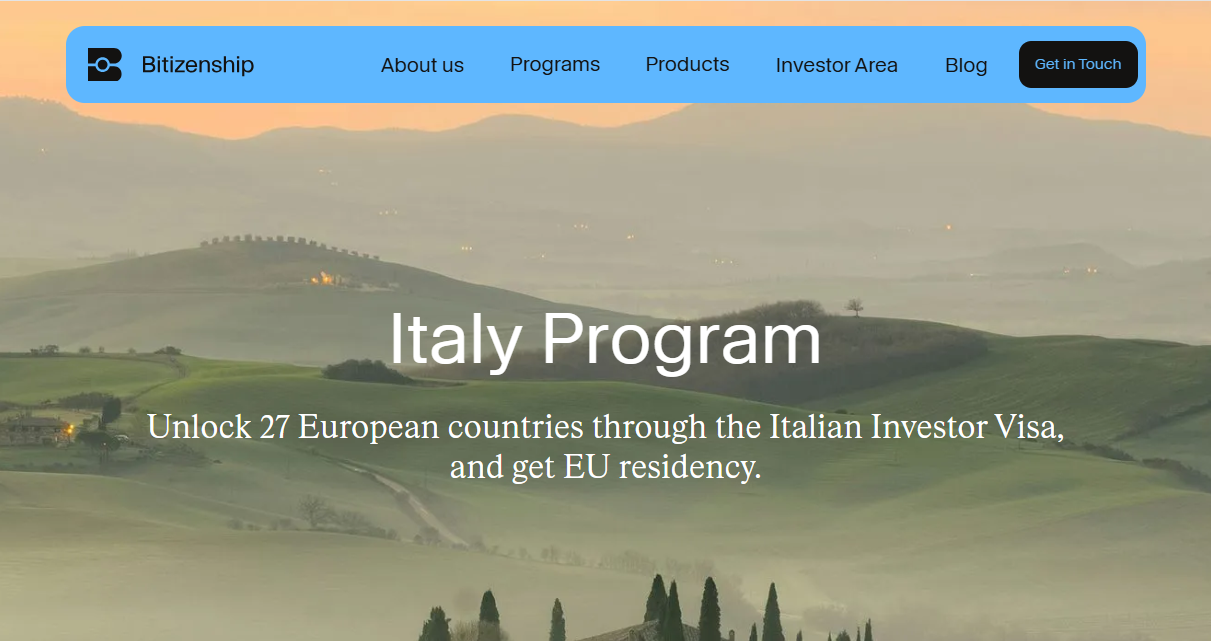
The Bitcoin Dolce Visa is Bitizenship's Italian Investor Visa pathway, built around a €250,000 equity investment in Bitizenship Italia S.r.l., a Milan-based Innovative Startup focused on the Bitcoin ecosystem. The investment is a euro-denominated equity stake in a startup, not a fund, and it carries startup risk.
Visa approval comes before capital is transferred, and processing typically completes in 3 to 6 months. Italy is a pure residency-by-investment route: permanent residency may be available after 5 years subject to requirements, and citizenship requires 10 years of genuine, continuous legal residence at 183+ days per year, plus B1 Italian and integration criteria.
Family Inclusion: The Inheritance Benefit Hiding in Plain Sight
Most owners think about inheritance as a transfer of title. The team at Bitizenship encourages clients to think about it as a transfer of access. A residence permit is personal and doesn't pass to heirs, which is exactly why including family in the original application matters so much.
Both Bitizenship pathways allow qualifying family members to be included:
- Spouse or partner.
- Dependent children.
- Dependent parents, depending on program rules.
- Each included member typically receives their own residence permit rather than a derivative status.
Picture the alternative. A US-based owner buys a home in Lisbon as a non-resident, dies, and the property passes tax-free to two adult children. The children now own a Portuguese home they can visit for 90 days in any 180-day period. They can't easily work from it, enrol children in local schools, or establish the habitual residence that would simplify their own eventual succession.
A family that pursued residency together starts from a very different place: each heir can live, work, and build a life around the asset they inherited.
"Most people save for a second home. The smartest ones save for a second passport. One gives you a better view. The other gives you and every generation after you options no amount of money can buy later." - Alessandro Palombo, Co-Founder, Bitizenship
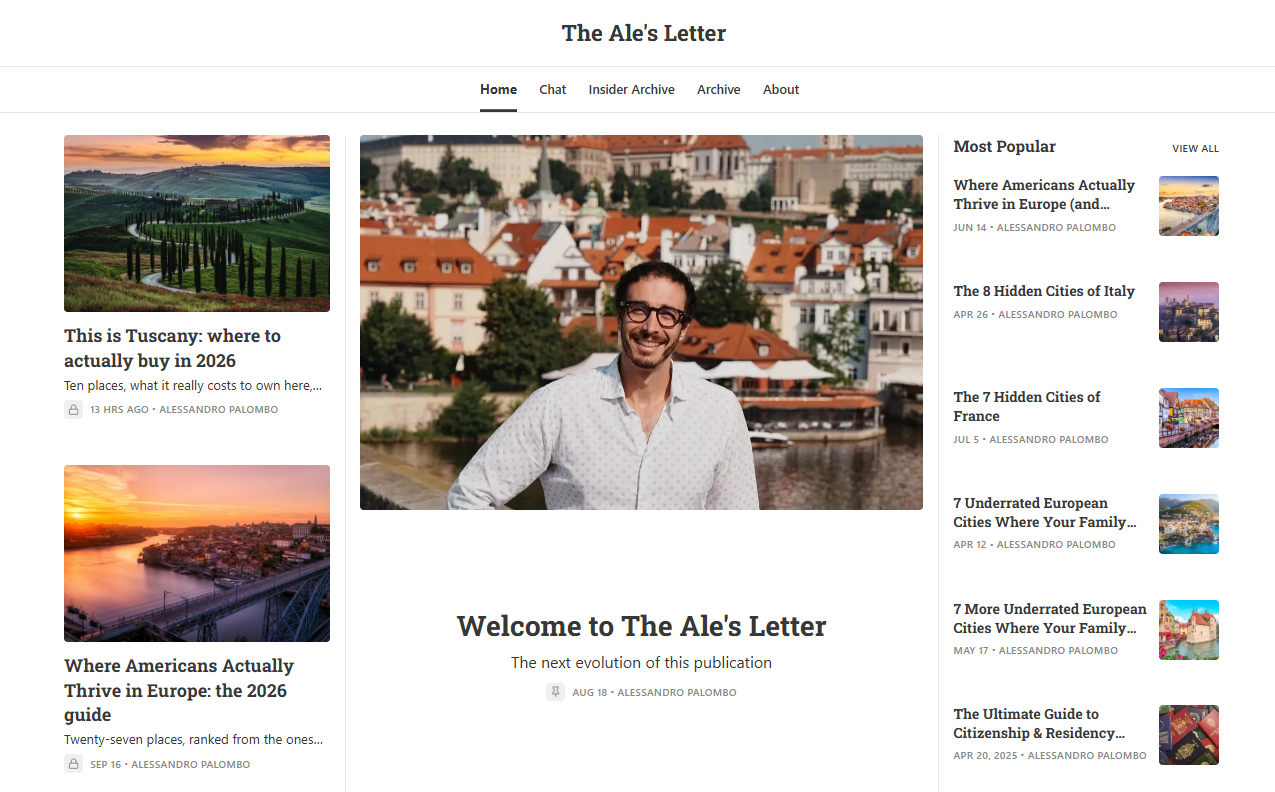
That is the core of Bitizenship's positioning on property and inheritance. The home is the asset. The residency is what makes the asset usable across generations. If you want the founder's longer-form thinking on this, Alessandro writes regularly about freedom, wealth, and global mobility in The Ale's Letter, and it's worth subscribing before you make structural decisions.
Wills, Documents, and the Cross-Border Estate Checklist
Residency creates options. Documents lock them in. Every property owner with European assets should have a coordinated estate file that works in at least two jurisdictions.
The minimum set the team at Bitizenship sees experienced advisors recommend:
- A home-country will covering worldwide assets, with a clause addressing European property explicitly.
- A separate Portuguese or Italian will limited to local assets, drafted so it doesn't revoke the home-country will.
- An express choice of law under Brussels IV if you want your nationality's law to govern.
- Apostilled and translated copies of key civil documents (marriage, birth, prior probate) held locally.
- A local tax number for each intended heir, which is required to register inherited property in both countries.
- For Bitcoin holders: documented source of funds and custody instructions, since heirs will face the same scrutiny you did.
One more practical point. In Italy, the succession declaration must be filed and tax self-assessed within 12 months of death, and since 2025 the tax is self-assessed within 90 days of filing. In Portugal, the stamp duty declaration is due by the end of the third month after death. Heirs who already hold residency and local tax numbers meet these deadlines far more easily than heirs scrambling from abroad.
You'll find more on the tax side of holding property as a resident in 5 real estate tax benefits for residents of Portugal and Italy.
Where Residency Doesn't Help, and What Can Go Wrong
An honest guide names the limits. EU residency is a strong tool for protecting property for heirs, but it isn't a shield against every risk, and some owners will be better served by other structures.
Residency won't fix these on its own:
- Home-country estate or inheritance tax. A US citizen remains subject to US estate tax on worldwide assets; a UK-domiciled owner may still face 40% UK inheritance tax, with only unilateral credit for Portuguese stamp duty paid.
- Forced heirship if local law applies and no valid choice of law was made.
- Disputes between heirs, which residency does nothing to resolve.
- Liquidity. Heirs may inherit a valuable but illiquid asset alongside a tax bill in another country.
- Program change. Portugal's Nationality Law was revised in 2026, and residency programs across Europe have tightened; the residency clock and citizenship clock now both start at first residence card issuance in Portugal.
There's also a timing reality. In Portugal, the wait from Golden Visa application to biometrics ran 11 to 15 months as of mid-2026, so the 5-year permanent residency clock realistically starts 17 to 27 months after filing. Italy is faster at 3 to 6 months, but its citizenship route demands a decade of genuine presence.
Neither program guarantees residency approval, permanent residency, or citizenship, and both investment vehicles carry the risk of capital loss. If your only goal is to pass a single property to your children tax-efficiently, a well-drafted will and local tax advice may be enough.
Residency earns its place when you want your heirs to inherit a life in Europe, not just a deed, and when you want family mobility and Schengen access as part of the same plan.
Bitizenship's second passport benefits guide covers the mobility side in more depth.
How Bitizenship Approaches Property, Residency, and Succession
Bitizenship is an international fintech and advisory firm building compliant, Bitcoin-aligned residency and citizenship pathways for global investors. The team has managed 150+ visas, works with 25+ professionals across its legal and tax partner network, and structures its investment vehicles in Portugal and Italy under founder-led legal oversight.
For property owners thinking about heirs, the approach looks like this:
- Program selection based on where the family's property, presence, and long-term intentions actually sit.
- Family inclusion planned from the first application, so heirs hold their own status.
- Introductions to vetted legal and tax partners for wills, choice-of-law elections, and cross-border tax coordination.
- Administrative support across the full procedure, from documentation to biometrics to permit issuance.
- Clear framing of what each pathway does and doesn't do: Portugal is a Golden Visa-eligible fund pathway, Italy is an Investor Visa startup equity pathway.
Bitizenship's take: the owners who protect property best for the next generation are the ones who stop treating residency and estate planning as separate projects.
The residency decides where your family can live. The estate plan decides what they receive. Doing both at once, with the same advisors in the room, is where the real inheritance benefit comes from.
Conclusion
EU residency inheritance benefits go well beyond tax rates. Residency in Portugal or Italy can shape which succession law governs your estate, give your heirs the standing to live in and manage what they inherit, and, in Italy's case, fold foreign-asset inheritance into a predictable flat tax regime.
Portugal levies no inheritance tax on direct-line family transfers; Italy taxes spouses and children at 4% only above €1 million per heir. Neither outcome is automatic, and residency is not a substitute for a coordinated will, a choice-of-law election, and professional tax advice in every jurisdiction that touches your family.
What residency does is turn a property into something your heirs can actually use. Bitizenship structures compliant pathways to that residency through its Portugal Fund and the Bitcoin Dolce Visa, with family inclusion and vetted legal and tax partners built into the process.
Get in touch to discuss which pathway fits your property and your family.
Read Next:
- Why Getting Residency Pays Off More Than Just Buying a Second Home in Europe
- The Real Estate Advantage of EU Residency: What Changes Once You're No Longer "Just a Foreign Buyer"
- How Portugal's New Tax Regime Rewards Real Estate Investors Who Hold Residency
FAQs:
1. Does EU residency reduce inheritance tax on my European property?
Not directly in most cases. Portugal exempts spouses, children, and parents from inheritance stamp duty on Portuguese assets regardless of residency, and Italy applies its 4% rate above €1 million per direct heir on Italian-sited property whether or not the owner was resident. Where EU residency does matter is in the surrounding framework: it can support a single-jurisdiction succession under Brussels IV, and in Italy the flat tax regime for new residents covers inheritance and gift tax on foreign assets. Bitizenship connects clients with tax partners who model these interactions before any residency decision is made.
2. How does EU residency affect which succession law applies to my estate?
Under the EU Succession Regulation, the law of your habitual residence at death governs your estate by default, unless you elect the law of your nationality in a will. EU residency in Portugal or Italy, combined with genuine presence, a local tax number, and other ties, helps establish that habitual residence and gives you the choice of which rulebook applies. Bitizenship's Portugal and Italy pathways include administrative support and introductions to legal partners who can draft the necessary choice-of-law provisions.
3. Can my heirs inherit my EU residency permit along with the property?
No. Residence permits are personal and don't transfer on death, which is why family inclusion in the original application is such an important inheritance benefit of EU residency. Qualifying spouses, children, and dependent parents can be included in both of Bitizenship's programs, so heirs typically hold their own permits by the time they inherit the property, allowing them to live in and manage it rather than being limited to short Schengen stays.
4. Which is better for protecting property for heirs, Portugal or Italy EU residency?
It depends on where the property sits and how the family intends to live. Portugal offers no inheritance tax for direct heirs, a 14-days-every-2-years stay requirement, permanent residency eligibility after 5 years, and a consequential path to citizenship without full relocation. Italy offers a lower €250,000 entry point, 3 to 6 month processing, no minimum stay to maintain the visa, and a flat tax regime that covers foreign-asset inheritance, but citizenship requires 10 years of genuine residence. Bitizenship structures both a Portugal fund pathway and an Italy startup pathway so families can choose based on their actual situation.
5. What documents should I prepare so EU residency actually protects my property for heirs?
At minimum, a coordinated home-country will, a local Portuguese or Italian will covering local assets, an express choice-of-law clause if you want your nationality's law to apply, apostilled civil documents, and local tax numbers for each heir. Bitcoin holders should also document source of funds and custody instructions, since heirs will face the same scrutiny during succession that the owner faced during the residency application. Bitizenship supports clients through the documentation stage and coordinates with vetted legal and tax partners in both countries.
Disclaimer:
This article is published by Bitizenship for informational and educational purposes only. It reflects Bitizenship's perspective on the investment migration market and is not intended as legal, tax, immigration, investment, or financial advice, nor as an offer or solicitation to subscribe to any investment product. Comparisons with other firms are based on publicly available information and our own assessment of structural differences in business models. We have aimed for accuracy, but descriptions of programs, regulations, and competitor offerings are necessarily summaries and may not capture every legal nuance. Program terms, eligibility criteria, processing times, tax regimes, and regulatory frameworks change frequently and vary by individual circumstances. The Bitcoin Dolce Visa involves an equity investment in Bitizenship Italia S.r.l., an Italian private company. Any investment decision should be made only after reviewing the official documentation and consulting independent legal, tax, and financial advisors qualified in the relevant jurisdictions. Past performance does not guarantee future results. Capital is at risk. Residency and citizenship outcomes depend on meeting all legal, language, residency, and integration requirements set by the relevant authorities and are never guaranteed. Always refer to official government and regulatory sources, and engage qualified professionals before acting on any information in this article.

Gain European residency and citizenship for you and your family. Enjoy the freedom to live, work, do business.
